
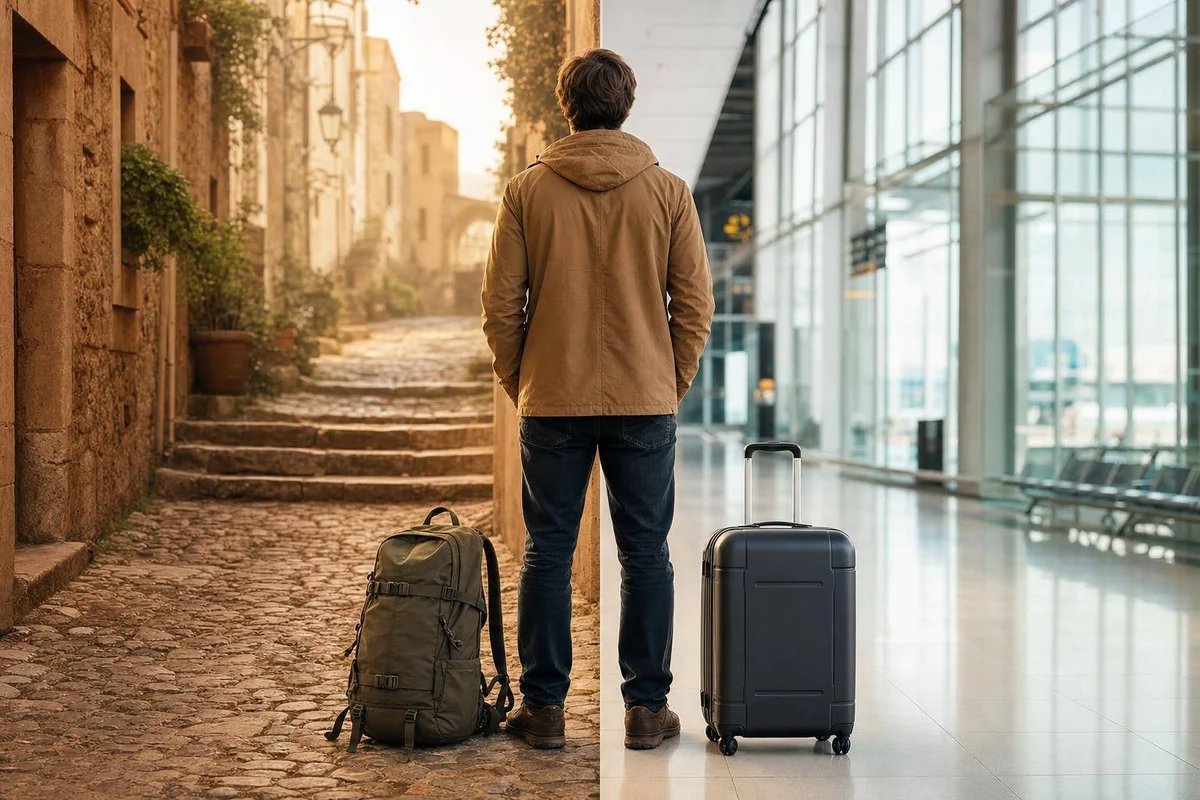
Choose your bag for the hardest transfer on your trip. Stairs, rough pavement and frequent hotel changes can favor a backpack, provided you can comfortably carry the packed weight. Smooth routes from airport to car to hotel can favor a rolling suitcase. Neither bag is automatically best for a short or long trip.
The useful questions are how often you move, what surfaces you cross, what you pack and how the loaded bag feels. Start with those rather than buying more capacity just because a trip lasts longer.
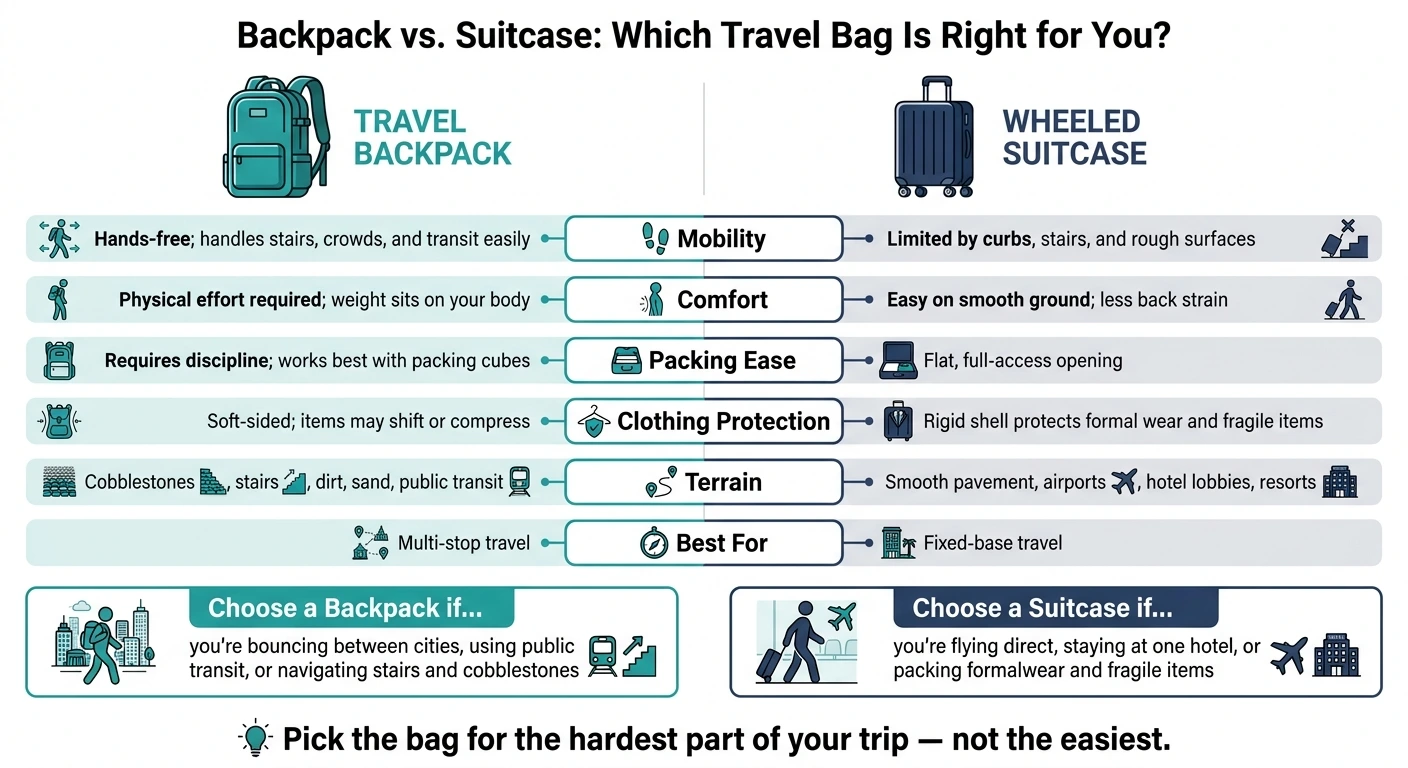
Backpack or Suitcase: The Quick Comparison
| Consideration | Travel backpack | Rolling suitcase |
|---|---|---|
| Stairs and rough ground | Leaves your hands free when worn; all weight is carried. | May need lifting or carrying. |
| Smooth floors | Still puts weight on your body. | Rolls with less need to carry the load. |
| Packing access | Depends on whether it opens from the top or like a case. | Often offers a broad, flat opening. |
| Clothes and fragile items | Needs careful organization and padding. | Can offer more structure, but does not prevent damage. |
| Airline acceptance | Packed dimensions and weight matter. | Outside dimensions, including wheels and handles, matter. |
Map the Trip Before Choosing the Bag
Write down the route from arrival to your accommodation, then each change of base. Include the final stretch from a station or parking area to the front door. A short staircase without a lift can matter more than hours on a smooth airport floor.
A backpack can be convenient for a route involving stairs, gravel or narrow paths. In crowded transit, take it off when appropriate so it does not hit other passengers or block space. A suitcase can be convenient when transfers are mostly paved and you can use lifts. Confirm those details with your lodging rather than assuming every hotel has step-free access.
Trip Length and Laundry
Longer trips do not always require larger bags. Repeating outfits and planning laundry can keep either style manageable. Cold-weather layers, special equipment or formal events may add bulk regardless of how many nights you travel.
Lay out your actual packing list before choosing capacity. A backpack labeled 30 or 40 liters is a starting point for comparing volume, not a promise that it fits your belongings or an airline allowance. Use the two-week carry-on packing guide to think through laundry and outfit choices before sizing up.
Test Comfort, Access and Protection
Pack the bag with a realistic load, then try walking, lifting it and using the handles. Test a backpack's straps and harness fit; test a suitcase's handle height and wheels. A bag that works empty in a shop may feel very different when packed.
Do not choose solely from a rule that a backpack is better for transit or a suitcase is better for back pain. Your strength, balance, mobility and route all matter. If carrying or lifting is painful, reduce the load and plan assistance or easier transfers rather than expecting a different bag to solve the problem.
Formalwear can be easier to arrange in a flat compartment. Fragile items need suitable padding in either bag, and a rigid shell does not guarantee protection. Keep important items accessible and check carrier restrictions before deciding what can travel in the cabin or hold.
Check the Actual Carry-On Rules
There is no universal carry-on size. IATA explains that allowances vary by airline, cabin class and aircraft. Check every operating carrier on your itinerary, including any short connecting flight, plus what your fare includes.
For one specific example, American Airlines currently lists a maximum carry-on size of 22 × 14 × 9 inches including wheels and handles, and notes that some airports and aircraft have additional restrictions. That is an airline example checked November 17, 2026, not a standard for all flights.
Measure a backpack when packed, including bulging pockets, and weigh either bag. Soft sides do not exempt it from the sizer or weight rules. A compliant carry-on may still need to be checked when cabin space is limited, so plan to remove essentials and any items the airline requires to stay with you.
The Five-Question Bag Test
- What is the hardest transfer? Note stairs, unpaved sections and distances.
- Can you manage the loaded bag? Test carrying, rolling and lifting before departure.
- Does it fit the actual packing list? Include laundry plans, footwear and special events.
- Does it meet your transport rules? Verify packed size, weight and fare entitlement.
- Can you reach essentials easily? Try opening it in the space available at your accommodation.
Pack It Well and Check Its Condition
Use compartments or packing cubes to stop small items disappearing into the main space. Keep a backpack's denser items balanced and close to your back, without hard edges pressing against you. In a suitcase, secure items so they do not shift when the case stands upright. Separate shoes and toiletries from clean clothing.
Inspect straps, zippers, buckles, handles and wheels before leaving. Secure loose backpack straps when checking it, following the carrier's handling guidance. Clean and dry the bag according to its maker's instructions after travel. Repairing a worn part may be more useful than replacing an otherwise suitable bag.
Finish with the travel packing checklist, then try the free travel money check-up before buying more gear. The right choice is the bag you can manage on your route with the things you actually need.