
Best Time to Visit Costa Rica (2026) — Dry Season, Green Season, and Where to Go
The best time to visit Costa Rica depends on what you want your trip to feel like.
Some travelers want easy beach weather, smoother roads, and simpler logistics. Others want lower prices, fewer crowds, and lush green scenery.
Costa Rica can deliver both—but not always at the same time.
For many travelers, the easiest time to visit Costa Rica is during the dry season, especially if the trip focuses on Pacific beaches, outdoor activities, and multi-stop itineraries.
But the green season can be an excellent choice if you want better hotel value, more flexible availability, and a more vibrant landscape.
The biggest mistake travelers make is assuming the entire country has the same weather pattern. It does not.
In this guide, I’ll break down the best months to visit Costa Rica, what dry season vs green season actually means, how the Pacific side differs from the Caribbean side, and which time of year fits beach trips, volcano trips, and first-time itineraries best.
Quick jump:
Quick answer •
Best month table •
Dry vs green season •
Month-by-month •
Best by trip type •
Regional differences •
FAQ
Compare hotel availability first so you can match your travel dates to the best regions, prices, and route flow.
Peak-season rooms in the best locations often disappear earlier than people expect.
Quick Answer: Best Time to Visit Costa Rica
If you want the simplest answer, January through April is often the easiest time to visit Costa Rica for beach trips, first-time itineraries, and smoother travel logistics.
If you want better value and do not mind some rain, May through November can be a smart time to go—especially if you are comfortable planning around greener conditions and occasional afternoon rain.
| Travel Goal | Best General Timing | Why |
|---|---|---|
| Easy first trip | January–April | Drier weather on much of the Pacific side and easier movement between destinations. |
| Best beach timing | December–April | Especially strong for Pacific beach regions like Guanacaste. |
| Lower prices | May–November | Green season often brings better hotel rates and lighter crowds. |
| Lush scenery | May–November | Rainfall usually brings greener landscapes and fuller waterfalls. |
| Caribbean timing | Varies | The Caribbean side follows a different weather pattern from the Pacific side. |
Best Month to Visit Costa Rica Table
If you want the fastest way to decide, use this table first. It turns the general season advice into a simpler planning guide based on what kind of trip you actually want.
| Best Month / Period | Best For | Main Tradeoff |
|---|---|---|
| January–March | Sunny Pacific beach trips, first-time visits, easier multi-stop itineraries | Higher prices and more crowd pressure |
| April–May | Good balance of decent weather, fewer crowds, and greener scenery | More weather variability as seasons shift |
| June–August | Green scenery, wildlife-focused trips, better hotel value | Humidity and more frequent rain |
| September–November | Budget-minded travel and quieter timing in selected regions | Wetter conditions on much of the Pacific side |
| December | Holiday travel, early dry-season feel in many Pacific areas | Peak demand builds quickly later in the month |
Costa Rica Timing Snapshot
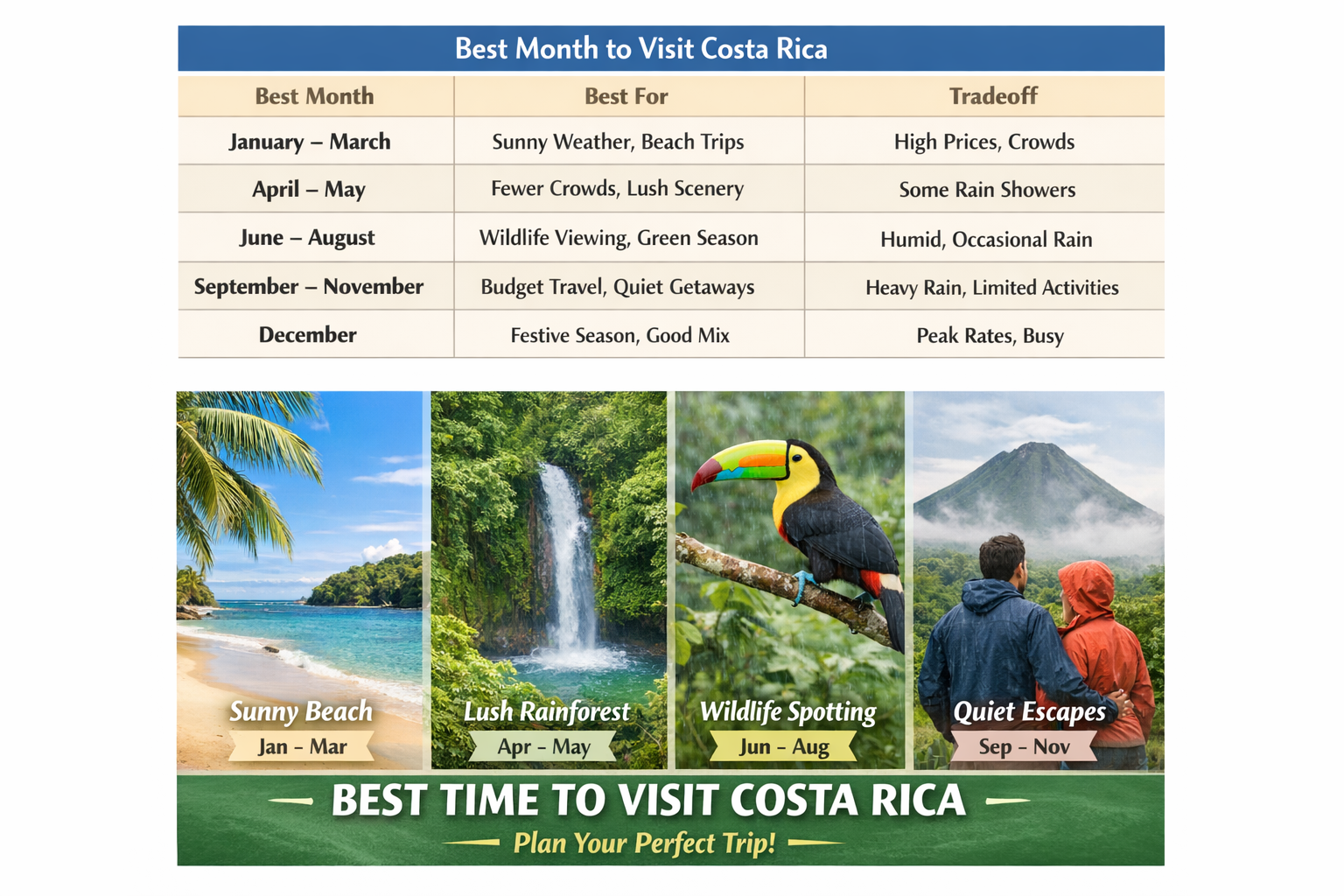
Dry Season vs Green Season
Costa Rica is often simplified into two main travel periods:
the dry season and the green season.
That simplification is useful, but it only tells part of the story.
Dry Season
Dry season is usually the easiest planning window for many travelers.
This is when Pacific destinations often have sunnier days, easier beach conditions, and more predictable travel flow.
It is also when Costa Rica is busiest, especially in strong beach and resort areas.
- Best for beach-first trips
- Best for easier road logistics
- Best for first-time visitors who want fewer weather surprises
- Usually more expensive
- Top hotel inventory can tighten fast
Green Season
Green season can still be a great time to visit Costa Rica.
This is often when landscapes look their best, waterfalls feel fuller, and hotel prices can be more approachable.
The tradeoff is that daily weather is less predictable, especially on the Pacific side.
- Best for lower hotel pricing
- Best for greener scenery
- Good for travelers with flexible expectations
- Can mean more afternoon rain
- Some transfer days may feel slower
Pacific timing, Caribbean timing, mountain weather, and local microclimates can feel very different.
Month-by-Month Costa Rica Weather Planning
January
One of the easiest months for many Pacific-side trips.
Great for beaches, resort stays, and classic first-time itineraries.
Prices and demand are usually high.
February
Often one of the strongest months for dry-weather travel.
Good for Guanacaste, beach itineraries, and multi-stop routes.
Peak-season demand remains strong.
March
Still a very strong month for Pacific-side travel.
One of the hotter and drier times in many Pacific areas.
Great for beach travelers, but expect crowd pressure and premium pricing in top destinations.
April
Usually still a good month, but often a transition period in some parts of the country.
This can be a nice bridge month if you want dry-season benefits without always being in the absolute busiest window.
May
Often the beginning of the greener period on much of the Pacific side.
A good option for travelers who want slightly better pricing while still catching plenty of enjoyable travel days.
June
A greener, quieter month for many Pacific destinations.
Good for travelers comfortable with some rain and more flexible planning.
July
Still part of the green season, but some travelers like July because it can feel manageable for a summer trip.
Good for travelers prioritizing value over perfect weather.
August
Lush and greener in many areas.
Fine for travelers who accept rain as part of the trip and care more about scenery and lower rates than dry-season predictability.
September
A more specialized month.
The Pacific side is often less ideal for travelers seeking easier beach weather, but parts of the Caribbean side can become more attractive around this time.
October
Similar to September in planning logic.
Not usually the first choice for a broad Pacific-first itinerary, but can still work if your timing and region match well.
November
A transition month that can be very interesting for value-focused travelers.
Conditions may begin shifting toward a more favorable travel window, depending on where you go and when in the month you travel.
December
December can be split into two different planning realities:
early December may still feel more transitional in some regions, while mid-to-late December becomes one of the most in-demand times of the year.
Not sure which month fits your route best?
Use the Travel With Glen Travel Planner to map your dates, destinations, hotel ideas, and route before you commit.
It is especially useful if you are comparing La Fortuna, Manuel Antonio, Guanacaste, and airport timing in one Costa Rica trip.
Helpful when weather timing, route flow, and hotel decisions all affect each other.
Best Time to Visit by Trip Type
Best time for beaches
For many Pacific beach destinations, the easiest beach months are usually December through April.
This is especially relevant for places like Guanacaste, where beach-focused travelers often want the driest and most straightforward conditions.
Best time for La Fortuna and volcano trips
La Fortuna can work across much of the year, but your experience changes with rainfall and visibility.
Travelers who want easier hiking and simpler transfer days often prefer drier windows, while travelers who want greener scenery may enjoy the greener months.
Best time for Manuel Antonio
Manuel Antonio tends to be easiest during drier Pacific-side timing, but it can still be rewarding in greener periods if you want fewer crowds and a more relaxed pricing environment.
Best time for a one-week first trip
If you are visiting Costa Rica for the first time and want a multi-stop route, the easiest timing is usually the drier part of the year.
That helps reduce weather complications, improve beach confidence, and make long drives feel less risky.
Pacific vs Caribbean: Why Timing Changes by Region
One of the most important Costa Rica planning truths is this:
the Pacific side and the Caribbean side do not follow the same seasonal pattern.
Pacific Side
The Pacific side usually has the more classic dry-season vs green-season rhythm that most travelers expect.
This is why beach travelers heading to places like Guanacaste often target the dry-season months first.
Caribbean Side
The Caribbean side has a different rainfall pattern and is not as neatly defined by the same seasonal logic as the Pacific coast.
That is why some Caribbean timing windows can work well even when the Pacific side is wetter.
If your trip includes the Caribbean side, do not assume Pacific timing automatically applies.
Holiday and Peak Demand Timing
Timing is not only about weather. It is also about demand.
Even a good-weather month can feel very different depending on holiday pressure and hotel inventory.
- Late December into early January: one of the busiest and most expensive times
- Spring break periods: can increase demand in beach destinations
- Semana Santa / Holy Week timing: often important for crowds and availability
- Peak dry-season months: stronger pressure on the best hotels and best locations
Sometimes the best “time” to visit is the time when your preferred hotels are still available at reasonable rates.
Cheapest Time to Visit Costa Rica
If your priority is value, the cheapest time to visit Costa Rica is often during the green season, outside of major holiday pressure.
This is when many travelers can find better hotel pricing and a more flexible booking environment.
- Better odds of lower hotel rates
- More flexibility in top destinations
- Less peak-demand pressure
- Tradeoff: weather is less predictable
Best Time for First-Time Visitors
For most first-time visitors, the easiest time to visit Costa Rica is usually during the drier part of the year, especially if the trip includes a mix of beaches, volcano country, and a multi-stop route.
That timing often reduces friction and makes the country feel easier to navigate.
If this is your first trip and you want the safest planning choice, build around the drier Pacific-side months, compare hotels early, and keep your route realistic.
Use the Travel Planner
Plan your dates, route, and hotel zones in one place
If you are trying to decide when to go, where to stay, and how to connect destinations like La Fortuna, Manuel Antonio, and Guanacaste, the Travel With Glen Travel Planner can help you organize the full trip.
Use it to line up your dates, hotels, region choices, and route before you book.
FAQ: Best Time to Visit Costa Rica
What is the best month to visit Costa Rica?
For many travelers, January through April are the easiest months because they often bring drier Pacific-side conditions and simpler travel logistics.
Is Costa Rica better in dry season or green season?
Dry season is usually better for easier beach trips and more predictable planning. Green season is often better for lower prices, fewer crowds, and greener scenery.
What months are rainy season in Costa Rica?
On much of the Pacific side, the greener or rainier season usually runs from May through November, with some transition around December depending on area.
When is the cheapest time to go to Costa Rica?
Green season is often the best value period for hotels, especially outside major holiday windows.
What is the best time to visit Costa Rica for beaches?
For many Pacific beach regions, December through April is usually the easiest beach window.
Does the Caribbean side have the same weather as the Pacific side?
No. The Caribbean side follows a different rainfall pattern, so it should not be planned exactly the same way as the Pacific side.